Double Standards in the Indian Legal System: One Suspended, One Still on the Bench
23 May 2026
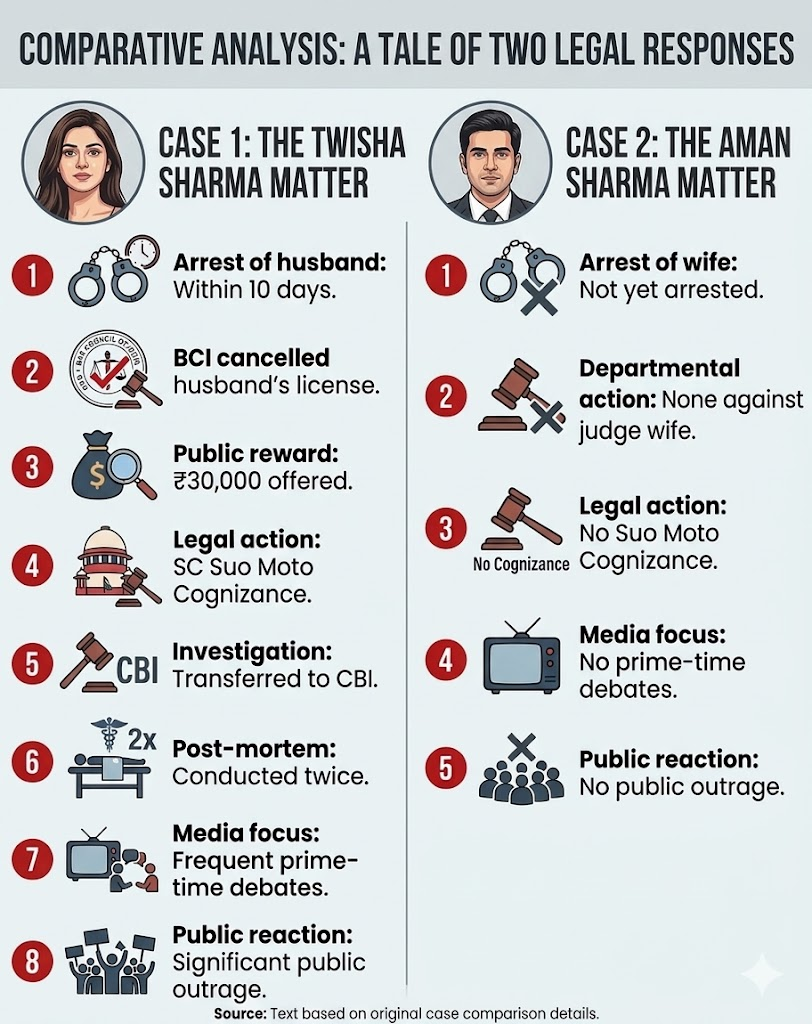
The Bar Council of India (BCI) has suspended advocate Samarth Singh from legal practice with immediate effect amid ongoing investigations into the death of his wife, Twisha Sharma. The BCI cited the "gravity of allegations" and the need to uphold public confidence in the legal profession.
However, in a starkly contrasting case, Swati Malik, a Judicial Officer and wife of deceased judicial officer Aman Kumar Sharma, continues to hold her position despite serious allegations of domestic harassment mentioned in her husband’s suicide note.
The Case of Samarth Singh & Twisha Sharma
Twisha Sharma, a former beauty pageant winner, died under suspicious circumstances shortly after her marriage. Her family filed an FIR against Samarth Singh and others, alleging dowry harassment and cruelty.
Taking prompt cognizance of the matter, the Bar Council of India issued an interim suspension order, stating that such serious allegations affect the dignity and public image of the legal profession. Samarth Singh’s license to practice law has been suspended until further orders.
The Case of Aman Kumar Sharma & Swati Malik
On May 2, 2026, Aman Kumar Sharma, a 30-year-old Delhi Judicial Services officer, was found hanging in his residence in Safdarjung, Delhi.
According to reports and family statements:
- Aman had informed his father about continuous mental harassment and domestic issues.
- He allegedly named his wife Swati Malik (Judicial Officer) and her sister Nidhi Malik (IAS officer) in his suicide note / dying declaration.
- He made a distress call to his father hours before his death, stating it had become "difficult to live."
Despite these grave allegations of abetment to suicide and domestic harassment against a sitting judicial officer, Swati Malik continues to discharge her duties as a Judicial Officer with no reported suspension or disciplinary proceedings initiated so far.
The Question of Consistency and Gender Neutrality
This glaring disparity raises serious questions about the application of professional accountability in India:
- A male advocate faces immediate suspension based on allegations.
- A female judicial officer facing similar allegations in her husband’s suicide faces no visible action.
The Indian Constitution under Article 14 guarantees equality before the law. Professional regulatory bodies — whether the Bar Council of India or the High Court/Supreme Court (for judicial officers) — are expected to uphold this principle without gender bias.
Broader Implications
Such selective enforcement severely damages public trust in the judiciary and the legal profession. When accountability appears to depend on the gender of the accused rather than the seriousness of the allegations, it undermines the rule of law.
Men’s rights organizations and legal observers have repeatedly pointed out that cases involving male victims of domestic abuse often receive delayed or muted institutional response compared to cases where women are victims.
Time for Systemic Reform
Both cases represent tragic losses of young lives. True justice demands:
- Fair, impartial, and time-bound investigations in both matters.
- Consistent application of professional disciplinary standards.
- Gender-neutral approach in matrimonial and domestic cases.
Until regulatory bodies like the Bar Council and judicial accountability mechanisms apply the same standards regardless of gender, questions about fairness and equality in Indian institutions will continue to grow louder.