Gender-Specific Rape Laws
Overview
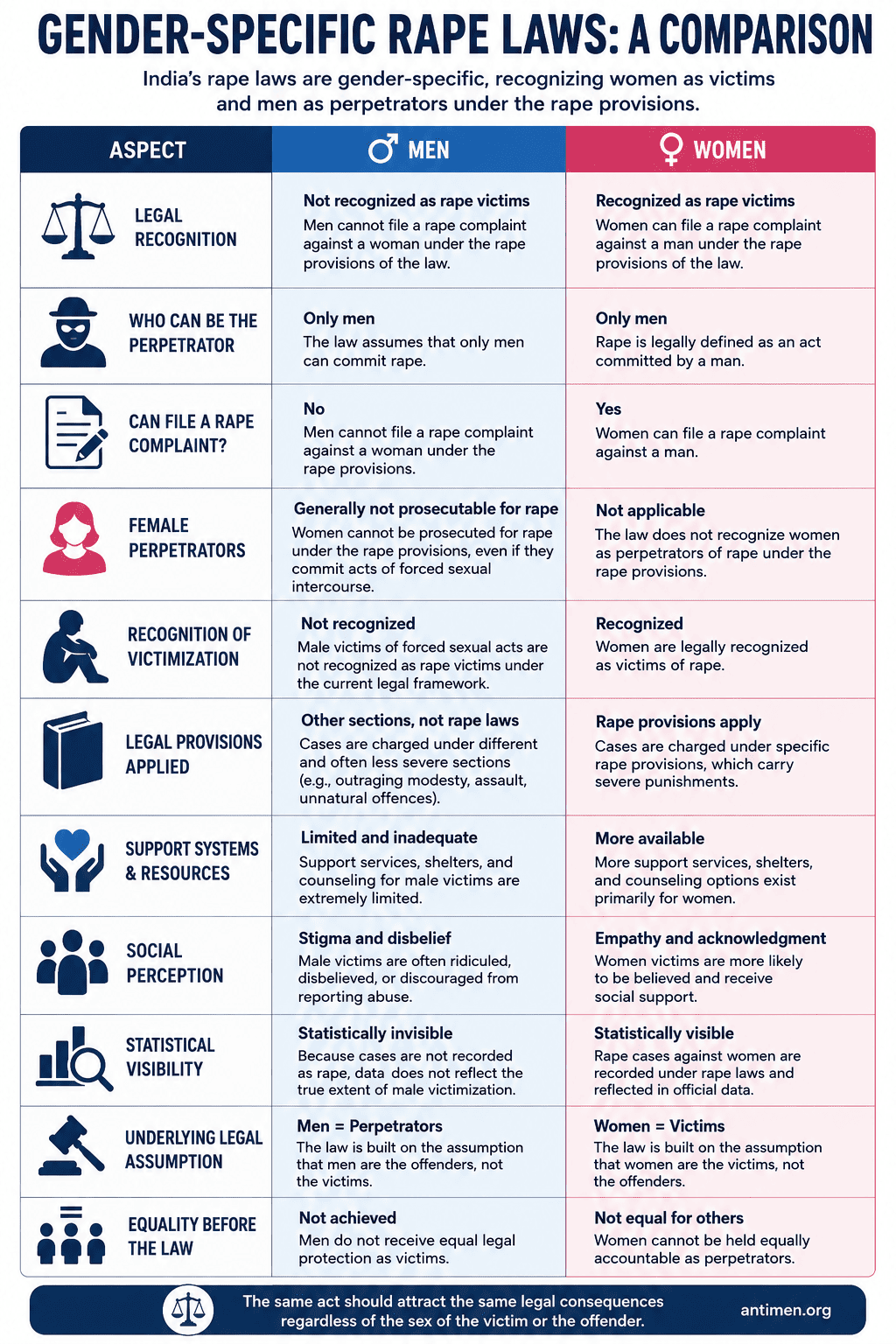
India's rape law is primarily structured around a male perpetrator and a female victim.
Under the Bharatiya Nyaya Sanhita (BNS), the offence of rape is generally defined as an act committed by a man against a woman under specified circumstances, including lack of consent.
The law was enacted to address the serious problem of sexual violence against women. However, critics argue that its gender-specific nature creates unequal protection under the law.
The Core Issue
The law recognizes:
- Women as victims of rape.
- Men as perpetrators of rape.
As a result:
- A woman can file a rape complaint against a man.
- A man cannot file a rape complaint against a woman under the rape provisions.
- Male victims of forced sexual intercourse are not recognized as rape victims under the same legal framework.
- Female perpetrators are generally not prosecutable for rape under the rape provisions.
Critics argue that the law is based on gender assumptions rather than the principle of equal protection.
Male Victims of Sexual Violence
Contrary to popular belief, sexual violence against men does occur.
Examples may include:
- Forced sexual acts.
- Coercive sexual activity.
- Sexual abuse during childhood.
- Sexual assault in institutions.
- Sexual violence within intimate relationships.
Men's rights advocates argue that victims should be recognized based on the crime committed against them, not their sex.
Female Perpetrators
The current framework assumes that rape is committed by men.
Critics argue that this creates situations where:
- Female offenders may not face equivalent charges.
- Comparable acts committed by women may be prosecuted under different and often less severe provisions.
- The legal system may fail to fully recognize certain forms of sexual violence.
Advocates of gender-neutral laws argue that criminal liability should depend on conduct rather than gender.
Impact on Male Victims
Male victims often face several challenges:
Lack of Legal Recognition
Many victims feel that the law does not acknowledge their experiences.
Social Stigma
Male victims may be ridiculed, disbelieved, or discouraged from reporting abuse.
Limited Support Systems
Most support structures for sexual assault victims are designed primarily for women.
Statistical Invisibility
When the law does not recognize certain victims, official crime statistics may fail to capture the true extent of sexual violence.
International Trends
Several countries have adopted gender-neutral sexual offence laws.
Under these systems:
- Men and women can be victims.
- Men and women can be perpetrators.
- Liability depends on the act and the absence of consent rather than the sex of the individuals involved.
Supporters argue that this approach better reflects the principle of equality before the law.
The Equality Argument
People argue that criminal law should follow a simple principle:
The same act should attract the same legal consequences regardless of the sex of the victim or the offender.
Under this principle:
- Any person can be a victim.
- Any person can be an offender.
- The focus remains on consent, coercion, and harm.
Conclusion
Sexual violence is a serious crime regardless of who commits it or who suffers from it.
Critics of India's gender-specific rape laws argue that a legal system committed to equality should recognize every victim and hold every offender accountable under the same legal standards.
The debate is not about reducing protections for women. It is about extending equal protection to everyone.